
Introduction
The English Baccalaureate was introduced as a performance measure in the 2010 performance tables. It is not a qualification in itself. The measure recognises where students have secured a pass or better across a core of academic subjects – English, mathematics, two sciences, history or geography and a language.
The government’s response to its EBacc consultation, published in July 2017, confirmed the government’s national ambition that 75% of Year 10 pupils in state-funded mainstream schools should be starting to study EBacc GCSE courses nationally by 2022 (taking their examinations in 2024), rising to 90% by 2025 (taking their examinations in 2027).
Whilst the government’s ambition is not a target for any individual school, Ofsted will consider the EBacc entry profile during inspection and indicate whether there is a risk that a school will not achieve the EBacc ambition as part of the ‘areas to investigate’ on the IDSR report.
The latest inspection handbook (published May 2019) indicates on p.43 that “inspectors will not make a judgement about the quality of education based solely or primarily on its progress towards the EBacc ambition. Nevertheless, it is an important factor in understanding a school’s level of ambition for its pupils. It is, therefore, important that inspectors understand what schools are doing to prepare for this to be achieved, and they should take those preparations into consideration when evaluating the intent of the school’s curriculum.”
In addition to the EBacc measure, there is an EBacc slot in the Progress 8 measure which may be filled by any three subjects which are eligible for inclusion in the science, humanities or language pillars of the EBacc.
Qualifications counting towards the EBacc headline and additional statistics
Which qualifications count towards the EBacc stats?
A full list of the qualifications that count towards the English Baccalaureate can be found on the Department of Education website English Baccalaureate: eligible qualifications. You can check to see if GO 4 Schools has recognised that your qualification will count towards the EBacc statistics by viewing the Subjects and qualifications page which is available under the Curriculum menu. Choose the year group that you are interested in and qualifying subjects will be marked with a "Y" in the "Is Eng. Bacc." columns.
From 2018 the only qualifications which will count as English, mathematics, science, history, geography, French, Spanish, German, Latin and classical Greek in the performance tables are the new reformed GCSEs (9 to 1) and AS levels.
From 2019 the only qualifications which will count as languages (other than Biblical Hebrew, Gujarati, Persian, Portuguese and Turkish, which are all being reformed in 2020) in the performance tables are the new reformed GCSEs (9 to 1) and AS levels.
GCSE Numeric qualifications (2017 onwards)
Students must have secured a grade 5 or better along with a complete pathway across a core of academic subjects – English, mathematics, the sciences (at least two grades), history or geography and a language. For qualifications that have not moved to the new GCSE Numeric schemes, students must have secured a grade C or better in the sciences (at least two grades), history or geography and a language to achieve the EBacc measure.
Since 2017, to meet the English requirement of the EBacc, exams in both English language and English literature must be taken and a grade 5 or above achieved in either (the best grade is used). For the English and maths attainment measure (also known as ‘The Basics’), a grade 5 in either English language or English literature counts and there is no requirement to take both. In Progress 8 and Attainment 8, there is no requirement to take both, but the best result is double weighted if the pupil has taken both.
Science – the best two grades are used in the EBacc measure. Students can follow one of two pathways:
- If the single sciences option is chosen, three out of four single sciences must be taken in physics, chemistry, biology and computer science from the eligible list, and grades 9-5 in 2018 onwards achieved in two of them.
- Since 2018 onwards, combined science counts as science in the EBacc if 9-9 to 5-5 grades are achieved.
Since 2018, when GCSEs in English, mathematics, science, humanities and (most) languages moved to 9-1 grades, students must have secured a grade 5 or better in these areas to achieve the EBacc.
Percentage of pupils entering the EBacc
Students are counted as ‘entered’ for the EBacc in GO 4 Schools in the following way.
Targets: In GO 4 Schools, for a student to count in the EBacc measure based on target grades, the student must be in subjects associated with the correct QAN codes for English language and English literature, maths, science, history or geography, and a language. If a student is included in these subjects but has no target grade, a target grade of U will be assumed.
Actuals: In GO 4 Schools, for a student to count in the EBacc measure based on actual grades, the student must have an actual grade for English language and literature, maths, science history or geography, and a language. If a student is included in these subjects but has no actual grades, a grade of U will be assumed.
EBacc Measures Displayed in GO 4 Schools
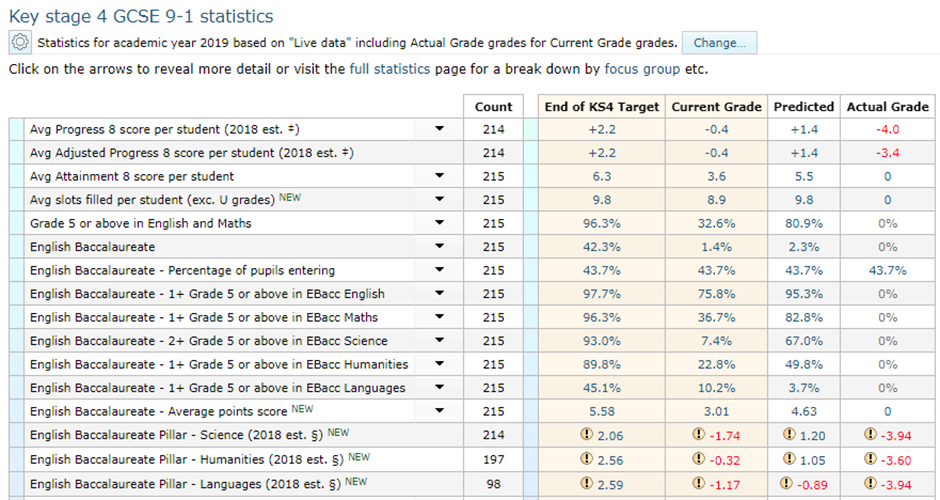
Several EBacc measures are shown on the year group page as shown below in fig.1 and on the full statistics page. These relate to the current EBacc attainment headline measure (EBacc APS) and previous headline threshold measures, now reported as ‘additional’ EBacc performance measures since 2018.
Fig1.
English Baccalaureate Average Point Score (EBacc APS)
Since July 2018 the headline EBacc attainment measure is the EBacc average points score (EBacc APS). This replaced the previous threshold EBacc attainment measure. EBacc APS measures pupils’ point scores across the five pillars of the EBacc. This ensures the attainment of all pupils is recognised, not just those at particular grade boundaries, encouraging schools to enter pupils of all abilities, and support them to achieve their full potential.
GO 4 Schools includes this new measure in the Key stage 4 statistics which is displayed in addition to the previous threshold EBacc attainment measure. It can also be expanded to see the average point score for each of the EBacc elements. See the example in fig.2.
Fig.2
It is calculated by allocating points to a pupil's best GCSE grades in the following areas:
- Best grade in either English language or English literature (both subjects must be taken, as with the current EBacc measure).
- Maths
- Science x2 - best two grades taken as follows:
- If the single sciences option is chosen, three out of four single sciences must be taken.
- Both grades for GCSE combined science.
- Best grade in either geography or history (Humanities)
- Best language grade
Science grades count as ‘two’ pillars, meaning a total of six pillars for EBacc APS.
These points are totalled for each pupil, with a zero for any missing subjects, and then divided by 6 to create an average point score per pupil. These scores are added together for all pupils in a school's whole KS4 cohort (rather than just those in the EBacc cohort), and divided by the number in the cohort, to calculate the EBacc average points score for each school.
EBacc Threshold Attainment Measures Displayed in GO 4 Schools
Strong Pass / Standard Pass
Since 2017, the DfE have published the percentage of pupils achieving a strong pass in all EBacc subjects (grade 5 or above in English and maths and grade C or above in unreformed subjects).
For transparency and to help schools show improvement over time, the DfE have also published the percentage of pupils achieving a standard pass in all EBacc subjects (grade 4 or above in English and maths and grade C or above in any remaining unreformed subjects).
The line ‘English Baccalaureate’ in fig.1 shows the percentage of students achieving a ‘Strong pass’ in the EBacc (grade 5 and above in English and Maths and grade C or above in unreformed subjects). The drop down can be used to see the percentage of students achieving a ‘Standard pass’ (grade 4 and above in English and Maths and grade C or above in any remaining unreformed subjects). This is a percentage of all students.
To know what this is as a % of students entered for the EBacc
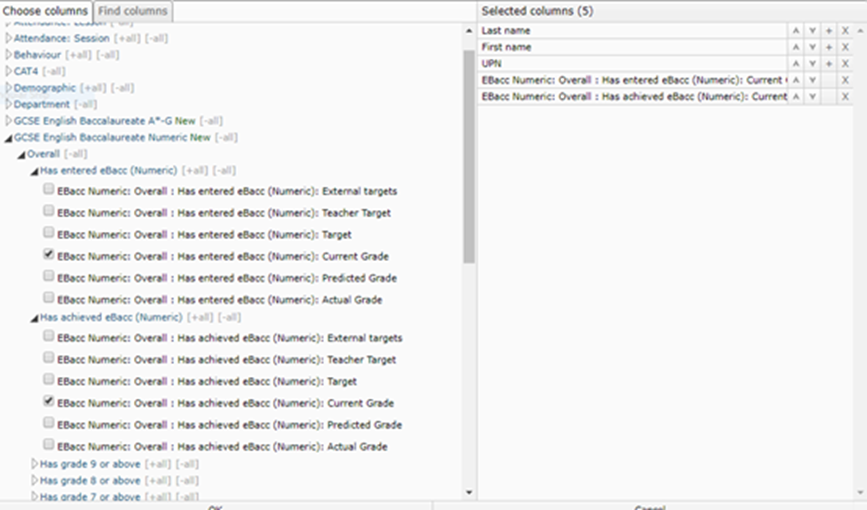
- In the new year group explorer select the following columns: (see example in fig.3)
- EBacc Numeric: Overall: Has entered eBacc (Numeric): Current grade
- EBacc Numeric: Overall: Has achieved eBacc (Numeric): Current grade
- Filter by the column ‘EBacc Numeric: Overall: Has entered eBacc (Numeric): Current grade’
- Sort by descending on the column EBacc Numeric: Overall: Has achieved eBacc (Numeric): Current grade
- Calculate the percentage as the number of Yes for achieved divided by the number of students entered
Fig.3
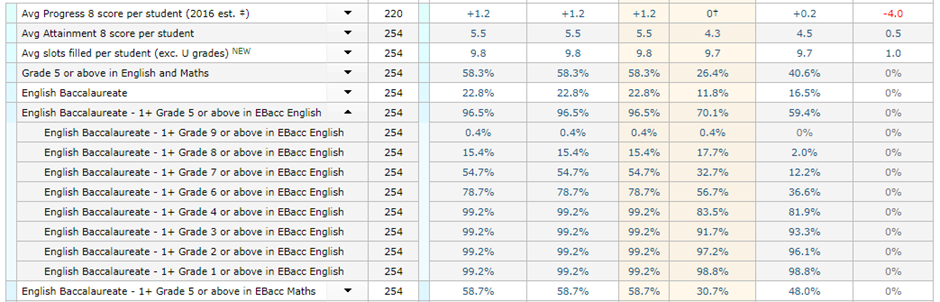
The subsequent lines in the table in fig1. show students’ achievements in each of the EBacc subjects/pillars. For example, the line ‘English Baccalaureate – 1+ Grade 5 or above in EBacc English’ shows us the number of students with grade 5 or above in one or more subjects that are eligible to be counted as English Language or English literature in the EBacc measure. (See the DfE list of eligible qualifications for which subjects are included.)
The drop down allows schools to see the number of students at each of the grades, as shown in fig.4.
Fig.4
These are calculated as the percentage of students achieving the measure for that EBacc subject as a percentage of all students.
Note. The DfE publish this as a % of students with entries eligible for that subject.[1]
For example, the current grade for ‘English Baccalaureate – 1+ Grade 5 or above in EBacc Humanities’ row in fig1. is showing the number of students who have a grade 5 or above in one or more eligible humanities subjects as a percentage of all students. To know what this would be as a percentage of students taking an eligible qualification, then
- In a new year group explorer select the columns
- EBacc A*-G: Humanities: Has entered eBacc: Current Grade
- EBacc A*-G: Humanities: Has achieved eBacc: Current Grade
- sort by EBacc A*-G: Humanities: Has achieved eBacc: Current Grade descending
- filter on EBacc A*-G: Humanities: Has entered eBacc: Current Grade
- calculate the % from the number of students with Yes for achieved divided by the number of students with Yes for entered
EBacc Pillars
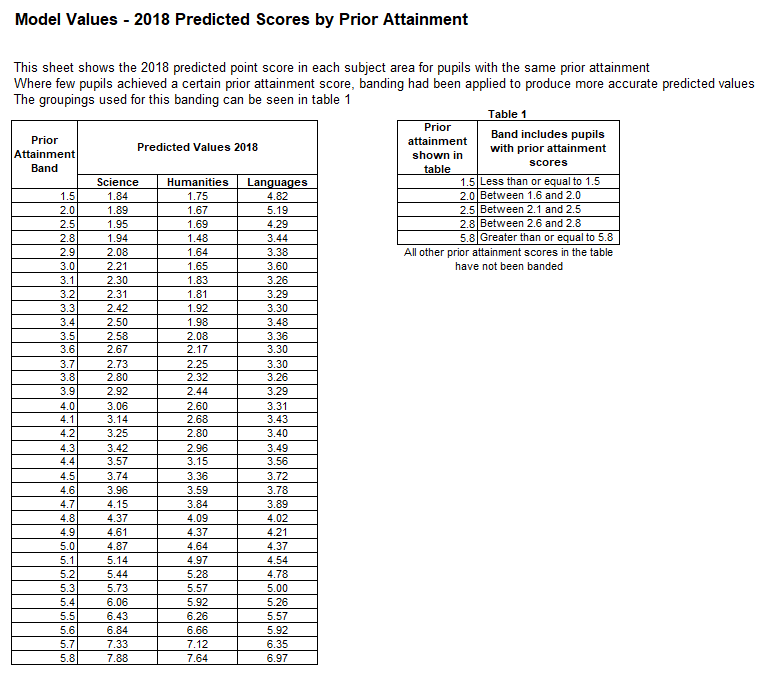
GO 4 Schools has further rows which show value-added scores for each of the separate EBacc pillars for science, humanities and languages. These are calculated in a similar way to Progress 8 scores, using the national EBacc subject estimates for all eligible students that achieved the same KS2 fine score. The latest EBacc subject estimates are available in the KS2-4 English Baccalaureate subject ready reckoner. As with P8, these value-added scores are dependent upon the performance of all students nationally and so cannot be accurately calculated until the estimates for that year have been published by the DfE. As such they should be used with caution. Schools can control which set of estimates are being used from the settings in Manage > School > Statistics and analysis settings (see example in fig.5). GO 4 Schools releases new sets of estimates as soon as they are released by the DfE. The Pillar estimates that were released in January 2019 are shown in Appendix A
Fig.5

We have not included confidence intervals for these scores because the DfE have not published details of the standard deviation of pupils scores nationally (which are necessary to calculate confidence intervals). Schools should however bear in mind the scores are subject to confidence intervals and that the smaller the cohort the larger the confidence interval.
Which students are included in the EBacc Pillar value-added measures?
These scores have been calculated only for students who are taking a subject that is eligible for that EBacc pillar (unlike the % of students achieving in each EBacc subject/pillar which is a percentage of all students as discussed above).
Where students have more than one eligible grade for a subject pillar then the best grade will be used. For example, where a student is doing both geography and history the best one of these will be used in calculating the value added for humanities.
Therefore, the number of students included in the pillars will vary between science, humanities and languages. Furthermore, only students with KS2 prior attainment uploaded to GO 4 Schools will be included in the measure (students with no ks2 prior attainment, for example those from overseas or the independent sector, are not included in the DfE measure).
Some figures may have a  next to them (see the current grade for Science Pillar in Fig1). This informs me that there are student(s) with missing grades, affecting the reliability of this figure.
For science, students must be studying either double science or 3 of 4 single sciences in GO 4 Schools to be included in the measure. An average of the students’ best two science grades are used to calculate the value-added score. However, if a student is in 3 single sciences in GO 4 Schools but is missing a grade for one of them the warning sign will not be shown as the best two grades will be used to calculate the measure and therefore the measure is not affected by the missing grade, as mentioned previously, it is treated as a ‘U’.
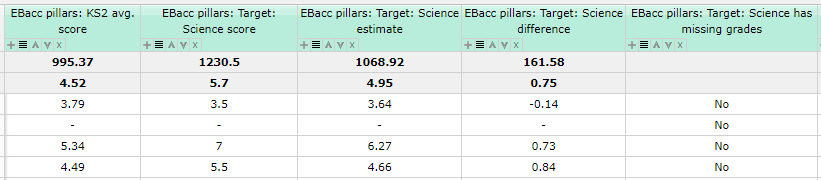
Columns are available in the new year group explorer to show the value-added scores for the EBacc pillars. See the example in Fig 6.
Fig. 6
Appendix A
Further information
For those interested in reading more about the impact of EBacc in schools the following links may be of interest:
Ofsted – School Inspection Update, issue 14 – July 2018 – ‘Implementing the EBacc in Schools – what inspectors will be looking at on inspection from September 2018’
Ofsted school inspection handbook for September 2019 onwards, May 2019 – School inspection handbook
Government briefing paper
https://researchbriefings.parliament.uk/ResearchBriefing/Summary/SN06045
Sutton Trust Research Brief ‘Changing the subject’ by Dr Rebecca Allen and Dave Thompson, Education Datalab
DfE 2018 School Performance Tables Statement of Intent 2018
[1] We are currently reviewing statistical outputs and considering additional updates to key statistics.