
The attainment over time page allows users to view performance measures by key stage, based on any selected grade type, focus group and side-by-side comparisons of snapshot data. This enables a quick view of changes of patterns in student attainment. The tables can be viewed using live data or easily downloaded for quick analysis of the key performance measures applicable to the key stage or the school-based assessment schemes your school has set up in GO 4 Schools.
The statistics will display using the same applied rules for the key statistics tables and using the appropriate applied methodology from Welsh Government. See the explanatory notes. The tables will also follow settings in GO 4 Schools including:
- Students statistics rule to remove any student from performance measures
- Excluding subject(s) from statistics
- All first entry rules
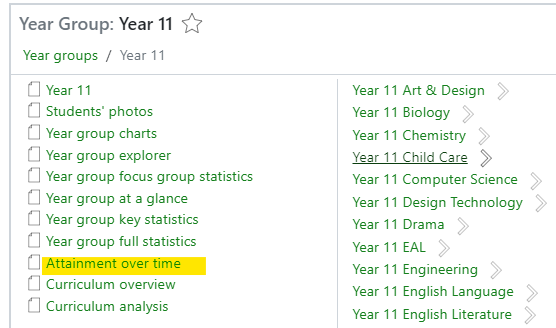
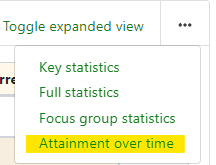
The attainment over time page for any year group can be accessed the Pathfinder menu > Year group > Attainment over time. It is also accessible via the Key statistics or from the year group At a glance page via the more options on the key statistics block of the page.
 Page features
The menu gives the user far more flexibility in the options of the data they wish to view:
Add measures
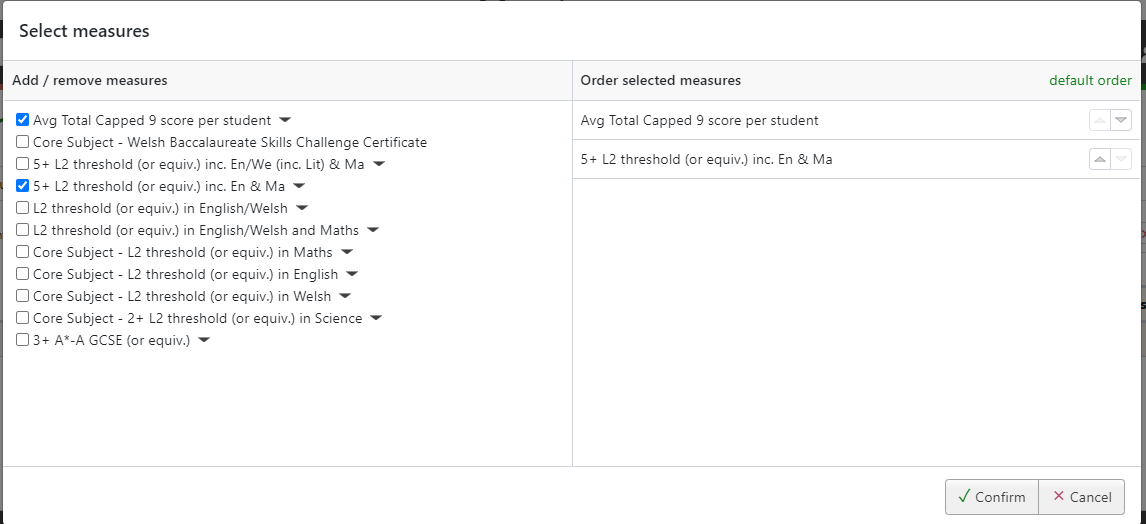
The Attainment over time page (AoT) has a menu to allow the user to select the measures for analysis, this means that specific details of the Capped 9, for example, can be reviewed more easily.
Once selected the order of the selected measures can be altered by the user by using the Order selected measures option on the right-hand side of the pop-up.
 Key stage 4 measures will be available in the first release then key stage 5 and school based assessment schemes will follow in a later release.
Add focus groups(s)
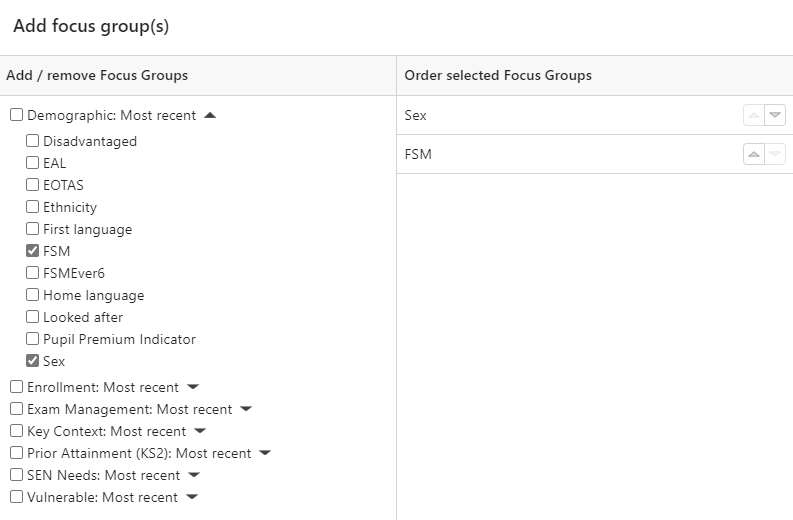
The focus group modal allows any student attributes set for analysis of attainment that is included in an attribute set to be selected. The groups will display by attribute set to enable selection for analysis.
Once selected from the attribute set the order of the selected focus groups can also be changed.
Select grade types
Users can select the grade types they wish to view. By default, all enabled grade types will be visible, but this feature allows, for example, the actual grade to not display in the table.
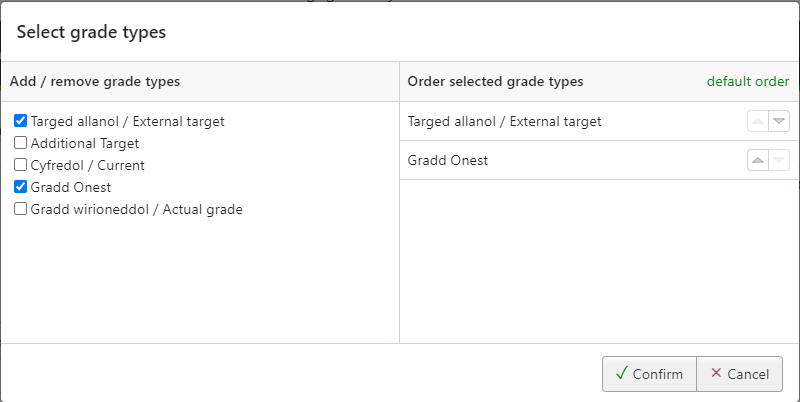
The pop-up allows you to select the grade types you wish to view and alter the display order.
Select snapshots
Once reports are prepared and a report snapshot is available, you can now select the data from each of the snapshots to view within the performance measures table to compare side-by-side. It is important to note that currently the snapshot will:
- Exclude subjects not included in the report.
- Exclude students not included in the report.
- Exclude grades not included in the report.
You may want to consider when completing a reporting cycle also completing a full data snapshot to ensure none of the data listed above is excluded.
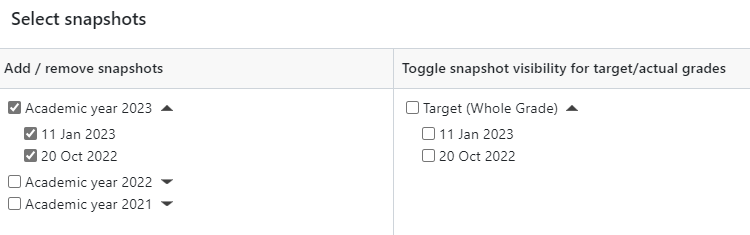
Note: In a follow up release we will be adding functionality to snapshot all data for all students, subjects, and grades as a Data snapshot, so when viewing whole school data such as the performance measures this reflects all information.
Load/save column sets
As with our data explorers you can also save selections to quickly reselect. These can be saved by the individual user or shared with other users for school-based data views. Any saved data views can be managed and renamed or deleted if no longer required.
To save a view simply select all the data from the menu required to display in the table; measures, grades, snapshots etc and then select ‘Load/save data sets’ from the menu, then ‘+ Save as a new selection’.
The pop up will give you the option of naming the saved data set and adding this to a group of similar data sets i.e., Y11 tracking data.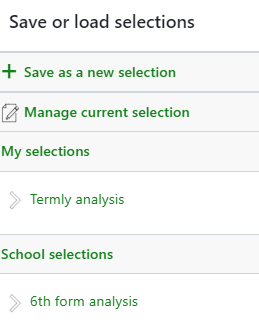
Note: Focus groups are not retained in the saved data set.
Downloading column sets
Once the table is set up as preferred you can then use the Download CSV to extract the table of data. Where the measure is a threshold, you can also toggle between displaying a percentage or count of students in the table to check for small numbers of entries.
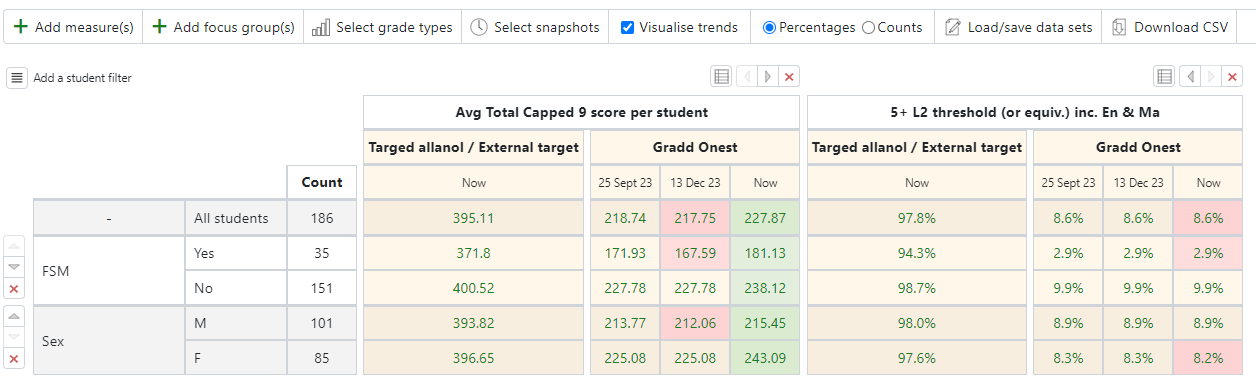
Student level data is visible via the mini-explorer pop-out when clicking on any number in the table. If data from a previous academic year is selected, then the link to the Data explorer will not be available.